
Brain
Set your positioning once.
Every draft is filtered through it.
The Brain holds your positioning, price range, tone, strengths, weaknesses and standing objections. Swiv reads it before it writes a single line for you.
What the Brain holds
A short set of answers. Each one changes what comes out of the drafts.
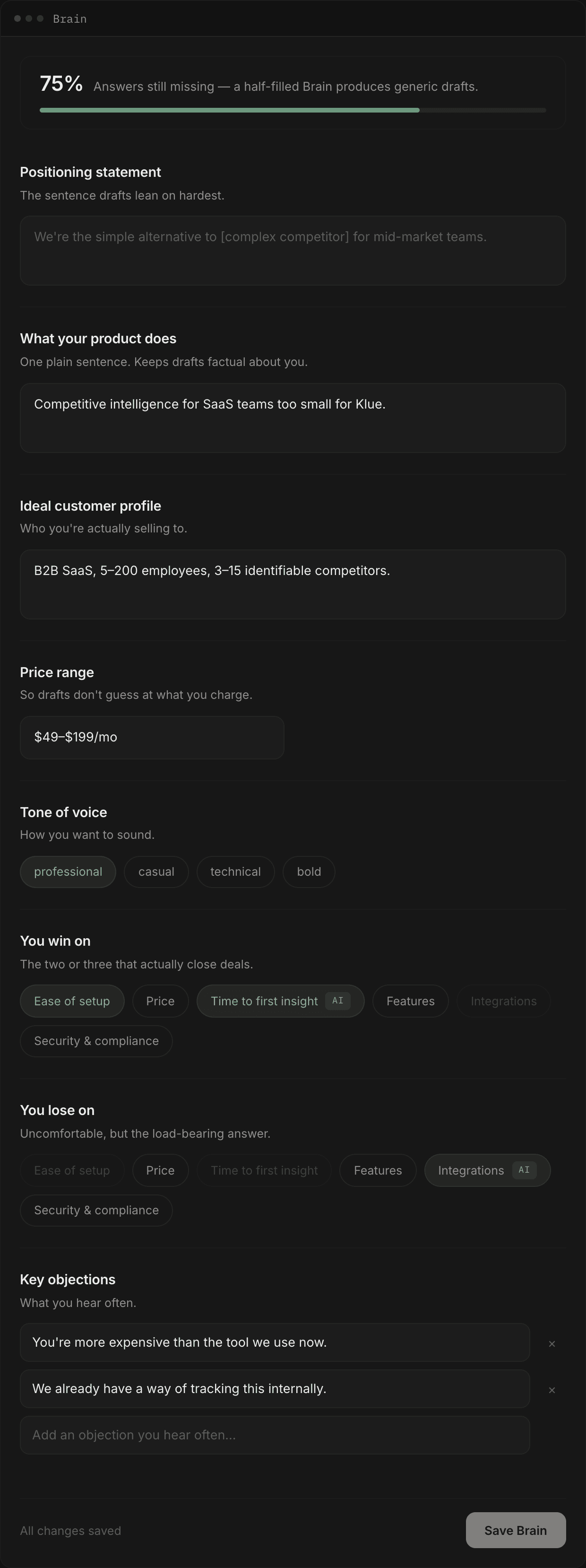
One question per row, each with a line telling you why it's being asked. You fill it in once and then mostly leave it alone — this is a screen you visit when your positioning moves, not a place you work.
Field by field
It asks for your positioning, what you sell and who you sell it to, the tone you write in, where you win and where you lose, and the objections you hear often. Nothing exotic — the things a good new hire would need in their first week, written down once instead of re-explained per draft.
What you get for it is drafts that already know your price sits where it sits, that your tone is yours and not the category's, and that there are comparisons you don't want invited. That's the difference between output you edit and output you rewrite.
What you lose on is the load-bearing part
Most tools only ask what you're good at. The result is copy that walks straight into the comparison you lose. Swiv asks for both, from a fixed list of competitive factors, so the answer is a decision rather than a wish list.
The four drafting agents use this directly. The objection handler concedes what's true about the competitor before it reframes, because a draft that pretends the objection is baseless gets deleted by the rep who reads it.
A half-filled Brain produces generic drafts
The screen tells you when answers are still missing, because the questions you skip are the specifics the drafts won't have. Leave enough of them blank and you get competent category copy that could have been written for anyone — which is exactly the thing you were trying to stop writing.
It also decides what counts as noise
Your ICP and positioning don't just shape the writing. They're how Swiv judges whether a competitor you track has made a move that matters to you — which is why how changes get scored for relevance isn't the same number for every company watching that competitor.
Where this connects
Fill it in once
A short set of questions, most of them a sentence or a few taps. Then every objection handler, brief, comparison page and positioning draft comes out sounding like your company instead of a category.