
Win/loss
Every deal already told youwhy you win and why you lose
Log the outcome and the reason in the words the rep or the buyer actually used. Swiv tags who it was about and what it was really about, so a quarter of one-line notes turns into a pattern instead of a pile.
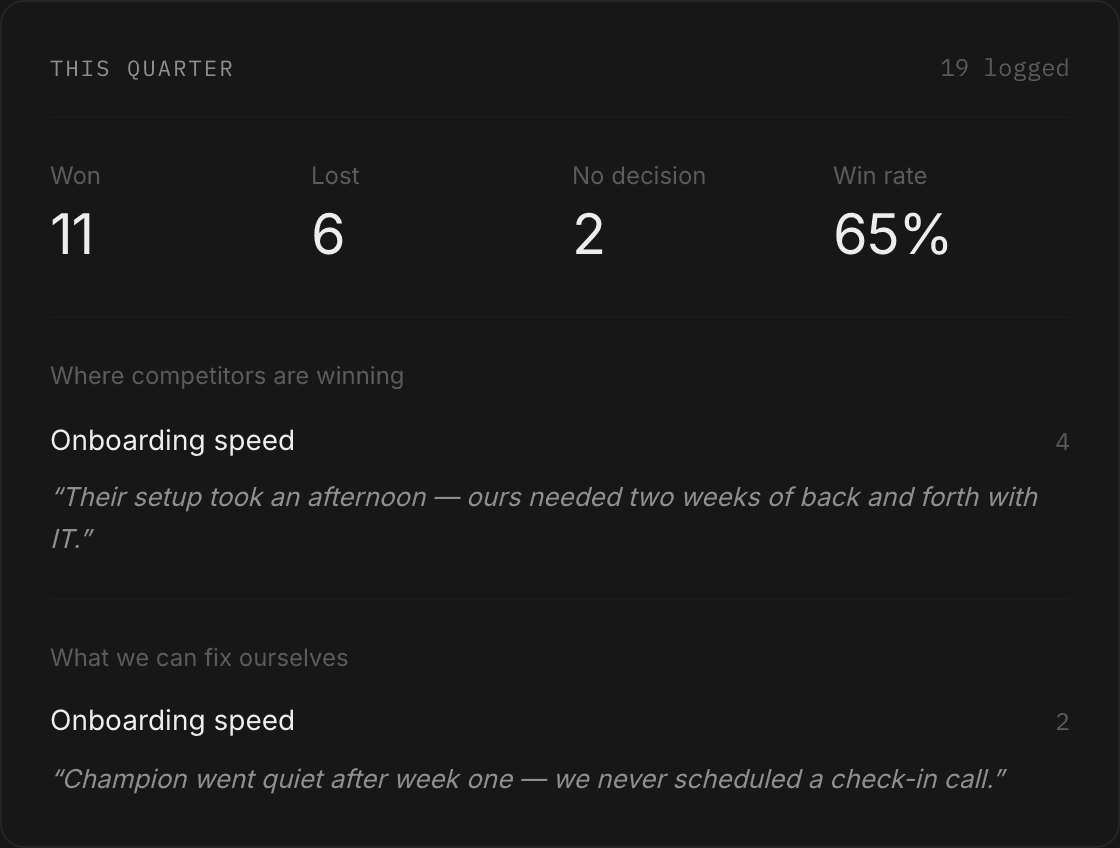
The log
Won, lost, or no decision — with the reason in one field
A rep enters an outcome and a reason after every deal closes: a sentence or two, in their own words. No form to fill out per competitor, no dropdown to guess your way through. The reason is the only field that has to be honest.
Swiv reads that sentence, works out which competitor it’s about — tracked or not — and what it’s really about: pricing, a missing feature, a slow onboarding, a budget freeze that had nothing to do with the product at all. You never fill in a category. You just say what happened.
Categories
Reasons sorted into what a rep can act on
Every log lands in one of a fixed set of themes, so a hundred loosely-worded reasons still add up to something you can read in a minute.
Pricing & budget
the deal you lost on price, and the one you lost to a frozen budget, are different problems.
Features & integrations
the gap a competitor closed, or the one they still haven't.
Onboarding & support
reasons that have nothing to do with the product itself.
Timing & trust
the deal-cycle mismatch, and the brand or category doubt that killed it.
The rollup
One competitor, sorted by what actually moves deals
Filter the rollup to a single competitor and see the themes that show up most in the deals you win and lose against them — with a sample reason under each one, in the words that were actually logged. Not a survey. Not a guess. What your own team already said.
A theme that shows up six times across six separate deals is a pattern worth fixing or selling around. One log saying the same thing is still just one deal.
The handoff
The pattern feeds every draft after it
The competitors you lose to most, and the reasons you lose to them, don’t stay on this page. They inform the factors you lose on in your Brain, which means every deal-prep brief and objection handler already knows where a competitor tends to beat you — and writes around it instead of pretending it isn’t there.
Where this connects
Log the next deal you close
Won, lost, or no decision — one field for the reason. The rollup starts filling in from the first entry, and it only gets more useful from there.